
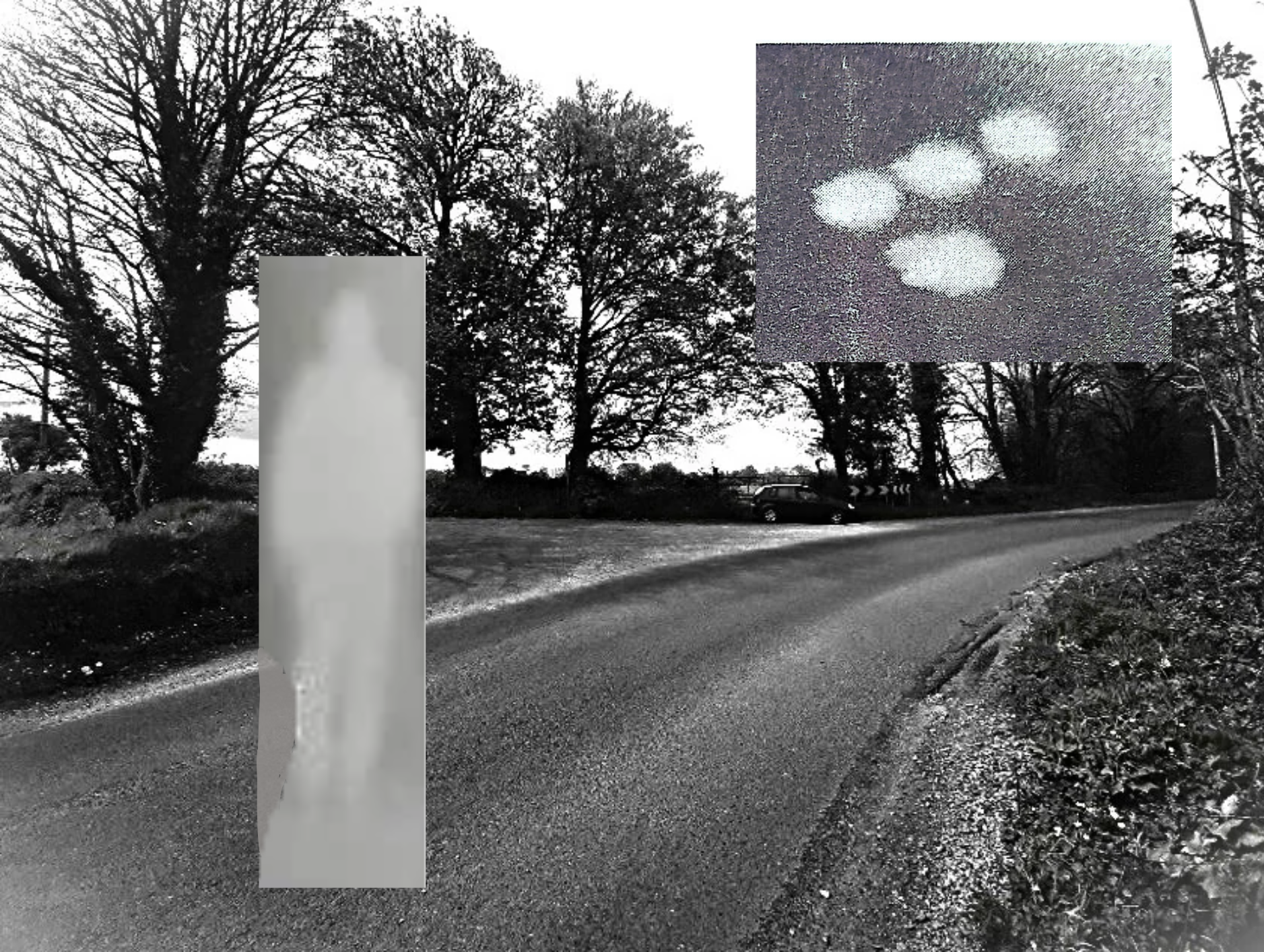
Work your day…an’ sleep your night, an’ let the evil take its flight
- some sound advice from a man seemingly not of this world, for the people of Sixmilebridge in south-east county Clare. It was taken from an account from Jimmy Armstrong of Ballyroughan, a townland north in Kilmurry parish, collected by the legendary Eddie Lenihan. Although the story takes place close to the nearby town of Quin, it exemplifies many characteristics of stories recounted of numerous encounters with seemingly supernatural entities in the area.
The strange man at the centre of this quote was found reading a book beside a graveyard at an ungodly hour of the night and he gives advice to those wanting to live in peace, to do their business in the daytime, but keep in their beds at night to avoid ‘the evil’. This ‘evil’ most often encountered at night, can take many forms. Interestingly, upon review, all the encounters detailed here not only take place at night, but on the roads leading in and out of old Sixmilebridge. rather than from within. Perhaps it is not surprising, as the town owes its existence as a place of passage rather than a destination; it takes its name from the essential crossing point over the Owengarney river and its distance being six old Irish miles from Thomondgate, Limerick city. Its fall from importance in the late eighteenth century was also ironically partially caused by another bridge, a toll bridge built by the unpopular landlord D’Esterre further downstream that cut off boat trade up the river and bypassed the town to land traffic. Interviews with local residents (kept anonymous) were conducted in 2022, where the modern-day encounters detailed inexplicably mirrored those recorded by schoolchildren in the 1930s, showing perhaps that at least in the hinterlands of Sixmilebridge, the old ‘evil’ of the night refuses to go away...
Fear Dubh/ The Black Man
Four accounts from the Schools’ Collection of the National Folklore Collection (housed in UCD, see Dúchas.ie) from Sixmilebridge National School written in the late 1930s give accounts of three separate encounters with a strange figure at night. He is referred in both English and Irish as the ‘Black Man’ or a ‘man in black’, which should be pointed out refers to a shadow like supernatural figure and not to skin colour or race. The witnesses are named in all accounts, which lends suggests there was sincerity in how the stories were believed to be true. The case of Martin Egan of Drumline, Newmarket-on Fergus Parish, was recounted twice by informant James Liddy. One account states:
One night Martin Egan of Drumline was returning home from this village between the hours of twelve and one o'clock. He was driving a bicycle and as he drew near Maurice's grand gate he got off it and began to walk. Just then a black man appeared by his side but he did not speak, The man disappeared at ‘Droicead na h-Abhann’ bridge. (NFC 0596: 302 Rossmanagher, Co. Clare)
In addition to this, Mr. Egan is said to have been led astray into a fort, and subsequently awoke in the Wells’ church, later finding his bike in the fort. The second iteration of the same story tells us this event happened about ten years previous.
A second encounter with the dark figure is detailed in the same manuscript and happened to farm labourer Pat Mullins. One night at Knockashanvo gap at the eastern end of the parish of Sixmilebridge, Mullins came upon a black man, whom he saluted, but go no response. The figure ‘walked by his side’ until Mullins sought refuge in a neighbours house, but later in the evening ‘got abad weakness’. He was sent to hospital where he died a month later (NFC 0596:325 Ballyroe, Co. Clare). The third story occurred to a group of men at night again and stated the man in black said nothing and disappeared (NFC 0596: 374 Sixmilebridge, Co. Clare).
Sightings of this dark figure in the parish have seemingly not stopped. A young informant interviewed in April 2022 with an address on the Rossmanagher road, a road leading south from the village towards Limerick, tells of their father’s encounter:
‘Dad sees stuff on this road the whole time, a man has walked beside my father twice coming down the road and he wears like… a really tall man with a top hat on and a long trench coat and just walks beside him doesn't say a word just walks beside him down the road’
They go on to blame the roads history as cause for this paranormal activity, pointing out the ‘Toll bridge’ (that same one that doomed the town in the 18th century) was ‘where the English were… people died on that road’. They also tell of their own encounter with what could be the same malevolent figure:
So there's this house on my road it’s like an old farmhouse, it's been abandoned for years and years but I was coming home one night, I was out with a few friends and I was walking home from up the village and whatever way I look towards this house there was like a face staring at me out a window. My father told me there's no window in that house anymore … it is bricked up no one has been in or out of that house in.. I'm gonna say over 20…50 years
The author is aware of two further past residents of the Rossmanagher road, of no connection our informant, who claim to have individually encountered a shadow figure on the route. These modern encounters retain elements of other stories. The allusion to deaths on the Rossmagaher road is found in the schools collection where a policeman haunts the site where he died at a fair near the Toll bridge (NFC0596: 303 Rossmanagher, Co. Clare). Another tale tells of a mysterious house and its inhabitants disappearing overnight (NFC 0596: 308 Rossmanagher, Co.Clare), which is in a similar vein to the modern encounter where the informant returns to find the window blocked up.
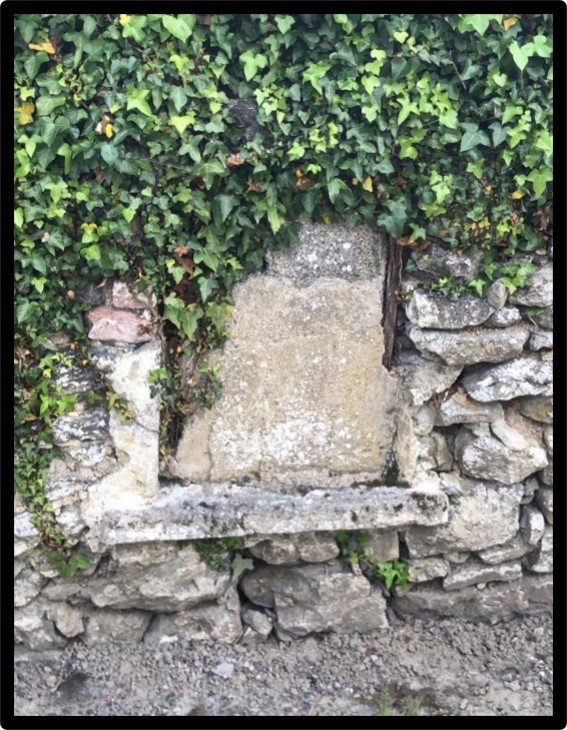
Blind window on Rossmanagher road wherein the informant claims she and two friends saw a face
Each of these stories of meetings with the ‘Black man’ share many commonalities. It occurs to travellers at night, walking of course. The man never speaks, but follows at the side of the traveller. An interesting element in the first tale is that the man disappears at a bridge, which showcases the widespread belief in Irish folklore that ghosts cannot traverse running water. Eddie Lenihan in his discussion on a tale of ‘the Latoon Hunt’ in his book Meeting the Other Crowd describes how in the Irish mind, stories of ghosts and fairies are closely connected. The first tale also involves a fairy fort, connecting what is seemingly a ghostly encounter with the fairies. All descriptions are some what vague, which famed antiquarian T. J. Westropp in his discussions on ghosts in the early 20th century suggests ‘the subject is usually regarded too seriously [by the informer] for verbal embroidery’.
The Lights
Tales of encounters with strange lights come from a route north of the village. A resident near Ballycullen in the east of Sixmilebridge parish tells in an interview conducted in 2022 of their encounter with ‘the lights’ at a crossroads in that townland:
…about 30 years ago myself and 4 or 5 friends were standing at the cross below in Ballycullen and we were waiting for a taxiit was a winter’s night and it was dark those nights, you didn't have drink in you before you went out so we were all sober standing at the cross. I had been standing out in the middle of the road and the taxi was late and I was looking up and down and these lights appeared on the road and I said stand in lads because there's a there's a car coming and no one paid any heed to me. But just as I looked to see which direction the lights were coming from they were coming from the tree above the lads’ heads who were standing in front of me ‘cause I was standing in the middle of the road. It was like a beam of light down at that cross, and the lights come down as a beam and landed in the road in front of me and I just said ‘lads, the lights! look at the lights!’ and they were there for a few seconds and I looked up again and the lights were gone and then everyone was looking at me and one of my friends in the group who had encountered the lights previously just mentioned ‘ah they’re the lights’ and I said ‘what lights?’ but she had encountered the lights further down, maybe 100 yards down the road further one night coming home on the bicycle with her friend years prior to that but these lights disappeared and my friends took no notice apart from the one girl’.
The informant was asked whether they associated them with any evil omens, ensuing tragedy, the fairies or a certain time of the year, but did not. They looked find a rational explanation but failed to do so.
The author recalls a childhood memory of family visiting one winter night, c. 2010, both driver and passenger ashen-faced and silent. One later explained they had encountered a glowing ball of light which forced them to stop the car in the middle of the road. It was said to have glided close to the ground, floating from one side of the road to the other before disappearing, at the same crossroads in Ballycullen.
In the Schools’ Collection of Cill Mhuire (Kilmurry), the neighbouring parish to the north-west, strange lights are sometimes associated with hidden treasure:
There was a light seen in the place where the hidden treasure is in Drumullan. It was seen by a few local men one bright night. First it was seen in the ground, then it went into the air and bursted in the air and disappeared. (NFC0596: 162 Ballysheen More, Co. Clare)
Another series of lights that protect buried treasure were brought upon by recent archaeological excavations of a crannóg on the lake of Rossroe:
…a boy was coming home one evening and he heard terrible moaning. He called others to hear and as they stood round they saw a very bright light rise from the ground and increase in size as it went up until at a certain height it burst and disappeared. So the old people say these lights have been seen there from time to time. (NFC 0596: 159 Drumullan, Co. Clare)
Treasure legends are very common in the Irish tradition. Folklorist Seán Ó’Suilleabháin suggests lines of enquiry into strange lights such as ‘those seen by law breakers or wrong-doers’, which may suggest the theme of treasure-seekers seeing the lights at Drumullan and in the aftermath of excavations at Rossroe are not out of the ordinary in wider tradition. Westropp makes reference in his work to ‘Will-O-The-Wisps’ and ‘Corpse Lights’ but none of his descriptions of these match the nature of the lights encountered in Sixmilebridge or Kilmurry.
The Death Coach
This manifestation is described as being both heard and seen at night along the country roads of the district. Jimmy Armstrong of Ballyroughan was interviewed by Eddie Lenihan in the latter half of the 20th century. He gives an account of hearing the ‘cóiste bodhar’ after eleven o’clock at night when on ‘cuaird’ (visiting) at a friend’s house in ‘Rath Lúb’ (Rathluby), a townland heading north towards Ennis in parish of Kilmurry:
Westood in the green talkin’, an’ the next thing we heard was all this screeching. Now, the best way I could describe it, ‘twas like an oul’ common car that didn’t see a drop of oil or a bit o’ grease for about forty years, an ’‘twas comin’ through Littleton’s place in Sean Daingean. The man o’ the house said to the rest of us “Come in” sez he, “an’ let that pass, whatever it is. An’ I don’t know” sez he “what road ‘twill take. But come back! Come in! That’s the cóiste bodhar if ‘tis in Ireland.”
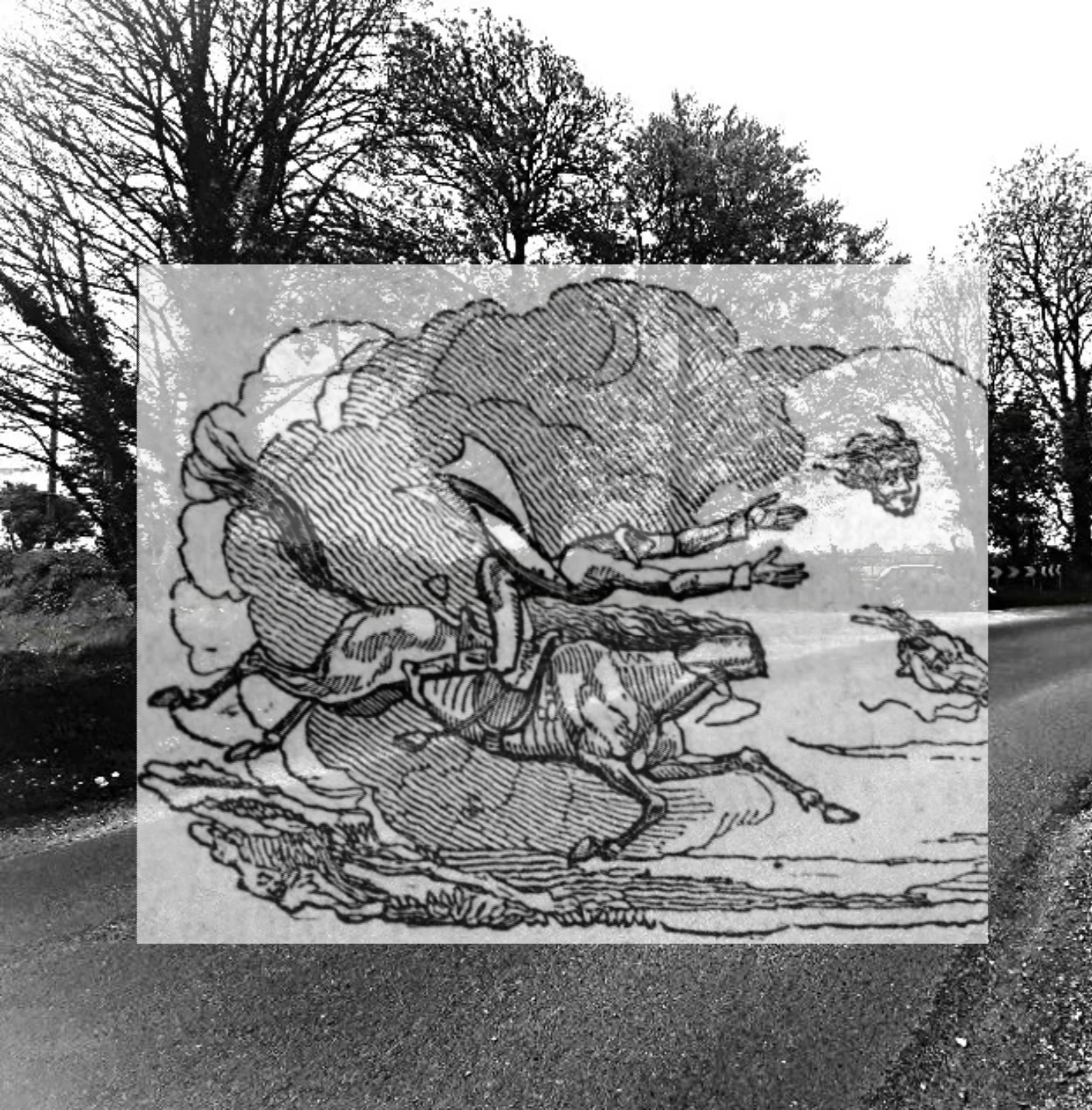
He goes on to say after finding refuge in to house the sound disappeared, but as the party went outside they could hear it again, and it eventually faded out over Ballyroughan Hill. An altogether more physical manifestation of this carriage is described in an account from Patrick Mulready of Ballyroe :
About twenty years ago three men went stealing apples from "Miss Butlers" orchard in Castlecrine. They entered the orchard about eleven o clock but they could get none. Just as they were about to come out, they heard a noise of a car coming towards them. They sat on the wall to let it pass by. When it was coming near them they saw it was a carriage with headless horses drawing it and a headless man driving them and they heard chains rattling inside in the carriage. The driver drove the horses so near the wall that he crushed one of the men's legs against the wall and hurt him. Next day the man got a weakness and died. (NFC 0596: 297 Ballyroe, Co.Clare)
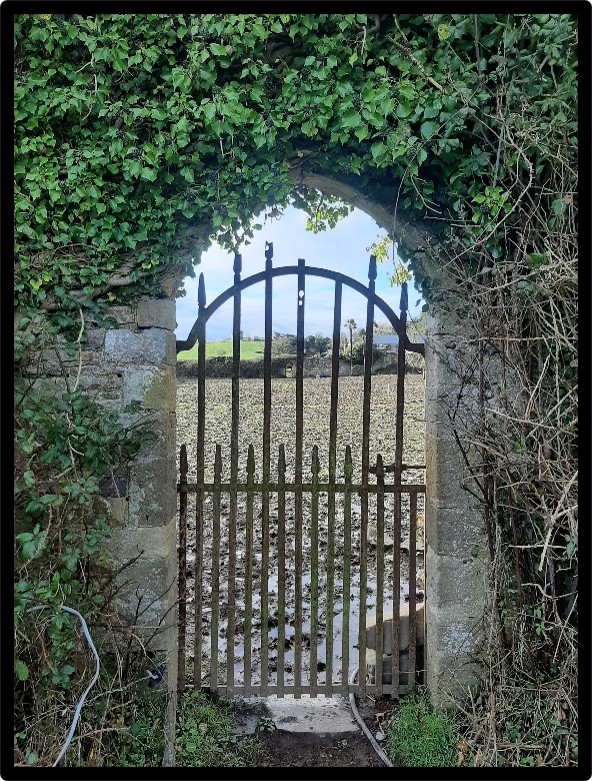
Entrance to the 18th century walled garden at Castlecrine, north of the town which was historically owned by the Butler family. The walls are still reffered to locally as the Orchard or Butler's Orchard.
A second account from the Schools’ Collection tells of two men heading to Limerick, who in order to avoid the toll bridge at Rossmanagher, took the longer road by Ballintlea. One of them turned around to see ‘a headless man’ at the heels of their cart, and they could not get their horse to move faster. The man only disappeared as they came close to crossing the river Garney, ‘because ghosts cannot pass over water’ (NFC 0596: 301 Rossmanagher, Co. Clare). This story may be connected to the death coach as it involves a ‘headless man’, or alternatively is another manifestation of the ‘black man’. Interestingly, the belief that ghosts cannot pass over water is repeated.
Our informant resident near Ballycullen told of Feenagh, a townland north west of Sixmilebridge:
There are stories of death coaches passing the house late at night, hearing hooves around the house… perhaps the graveyard as well in terms of the death coach going up and down the road that would be heard bringing somebody in the old, as I said, horse and carriage that was used a long, long time ago that's often heard going down the road.
Again, this an account where the coach is only heard, but interestingly it is associated with a graveyard, and is seemingly believed to be ‘bringing somebody’ in it. T.J. Westropp writes in the early 20th century that the ‘death coach’, ‘headless coach’ or ‘coach a bower’ is, in Clare, traditionally a foreshadower of death, not unlike the more infamous Banshee, but of a much later date in origin.
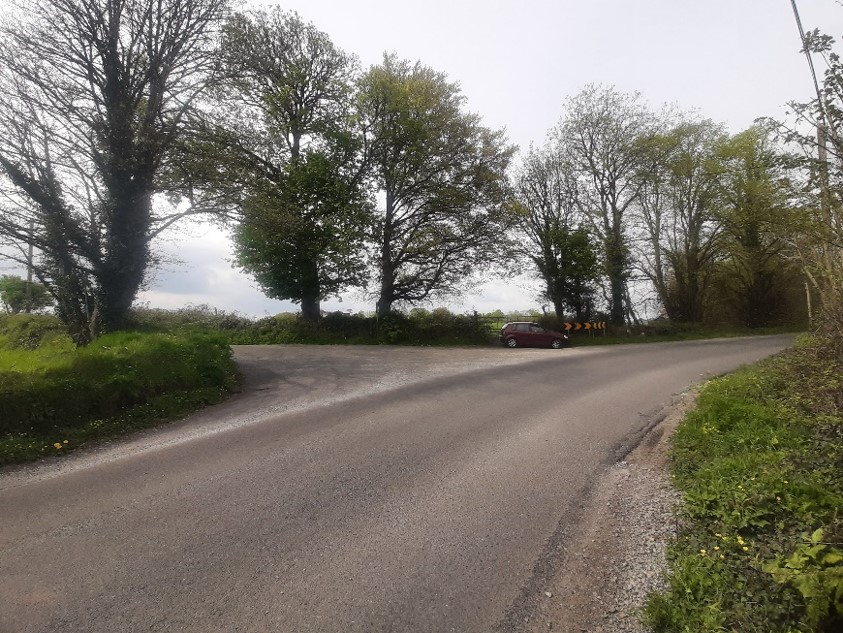
Crossroads at Ballycullen where strangelights were seen on at least two occasions.
His earliest account dates to 1806, and these accounts are again a mixture of sightings and only its noise being heard. Eddie Lenihan in Meeting the Other Crowd makes the point that this ‘unearthly vehicle’, its function, as well as where it comes from, vary widely. Some say it is the Devil’s coach, a fairy hearse, transport for the Banshee, as well as an omen of death. In the examples found in the parish, none can be said to comfortably fit into a one of these categories, except maybe the fate of the man stealing from Miss Butler’s Orchard. Did the carriage foretell his death, or cause it? It is worth noting that the informant in their interview describes the death coach in the same line of conversation as the fairies. She states that the friend built their house on a ‘fairy path’, and this was the reason for their troubles. Again, this may indicate there is a memory of an association between the two.
Conclusions
In general, the seen counters with the supernatural in the hinterlands and roads leading from Sixmilebidge contain certain elements that are well represented in the wider Irish tradition. Some of these include:
- The witness is ill-advised and travelling at night.
- The belief that ghosts cannot travel over water..
- A strong link between ghosts and the fairies.
- Weakness and/or death following an encounter
- Unexplained lights, often protecting buried treasure.
- The noise and sight of the Death Coach or ‘Cóiste Bodhar’
The case of the ‘Fear Dubh’ is unique to the area in some aspects. Descriptions of how he never speaks, even when saluted, and walks alongside the witness are consistent, and such consistency is hard to find in any other references to a ‘black man’ in the National Folklore Collection. There is less consistency with descriptions of strange lights and the death coach, and their connections to other supernatural entities are unclear. So from this, what conclusions can we come to about what place supernatural encounters hold in the modern consciousness? The older stories are obviously part of the rich collection of folklore that exists throughout Ireland in relation to the unexplained and supernatural. They come from a time where the reality of these beings and happenings was often unquestioned, before the advent of electricity and television that many cite as a watershed moment for the decline in the power they held over the population. However, the modern day first hand accounts from residents in the hinterlands of this modern, ever expanding commuter town throw a spanner in the works, so to say.
The author has confirmed that stories of encounters, except perhaps those of the named ‘death coach’, are told independent of any knowledge of the older stories or wider tradition. Even more compelling is multiple witnesses to the same manifestations have come to light with no connections to each other. Therein lies the question: Are the old stories, just old stories told for entertainment in the days before modern convenience, or are they in fact reports of true encounters with supernatural entities that continue to stalk the many roads leading to and from the historic crossing point of Sixmilebridge?
------------------------------------------------------------------------------------------------------------------------
Archival References
The Schools’ Collection. NationalFolklore Collection. University College Dublin. Volume 0596. Page 302.Rossmanagher, Co. Clare.
The Schools’ Collection. NationalFolklore Collection. University College Dublin. Volume 0596. Page 325.Ballyroe, Co. Clare.
The Schools’ Collection. NationalFolklore Collection. University College Dublin. Volume 0596. Page 374.Sixmilebridge, Co. Clare.
The Schools’ Collection. NationalFolklore Collection. University College Dublin. Volume 0596. Page 303.Rossmanagher, Co. Clare.
The Schools’ Collection. NationalFolklore Collection. University College Dublin. Volume 0596. Page 308.Rossmanagher, Co. Clare.
The Schools’ Collection. NationalFolklore Collection. University College Dublin. Volume 0596. Page 162.Ballysheen More, Co. Clare.
The Schools’ Collection. NationalFolklore Collection. University College Dublin. Volume 0596. Page 151. Drumullan, Co. Clare.
The Schools’ Collection. NationalFolklore Collection. University College Dublin. Volume 0596. Page 359. Cappagh North, Co. Clare.
The Schools’ Collection. NationalFolklore Collection. University College Dublin. Volume 0409. Page 082.Mountcoal, Co. Kerry.
The Schools’ Collection. NationalFolklore Collection. University College Dublin. Volume 0596. Page 297.Ballyroe, Co. Clare.
The Schools’ Collection. NationalFolklore Collection. University College Dublin. Volume 0596. Page 301.Rossmanagher, Co. Clare.
Secondary Source List of References
Ó’Suilleabháin, S. (1970) A handbook of Irish folklore.Singing Tree. Detroit.
Westropp, T.J. (2003) Folklore of Clare. ClaspPress. Ennis.
Almqvist, Bo (1991) ‘Crossing the Border: A Sampler ofIrish Migratory Legends about the Supernatural’. Béaloideas 59, pp.209-217.
Ó’Hógáin, D. (1995) Irish Superstitions. Gill& MacMillan, Dublin.
Lenihan, E.& Green, C.E. (2004) Meeting the Other Crowd. Jeremy P.Tarcher/Penguin, New York.
Holohan, P. (Edt.) (1991) Cill Mhuire Na nGall – AHistory of Kilmurry 1891-1991. Clare Champion Printers, Ennis.