“There Is a UFO portal about 25 feet into the lake. A portal is a doorway of some description, and the way we look at it in ufology is that it is a portal to another dimension,” says Betty Meyler in the 2009 documentary ‘UFO’ by Pete Higgins. Higgins filmed Betty sitting in a small boat on Lough Key in County Roscommon. She sits bundled up in a large, striking red coat as she takes a crystal on a chain from her pocket and says, ‘When I'm over the portal, I am going to ask the question, ‘Where is the portal?’ And if it goes round and round, it’s a yes.”
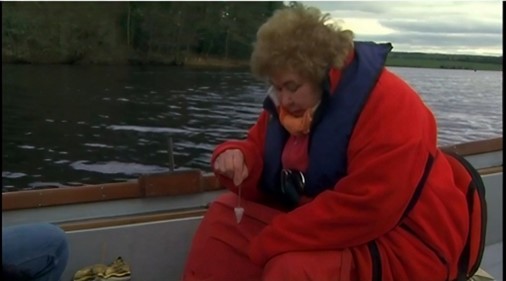
Betty Using her pendulum to locate the UFO portal under Lough Key
Betty Meyler was the president of the Boyle UFO Society of Ireland (UFOSI), a paranormal investigation group that boasted hundreds of members and held numerous conventions that attracted enthusiasts from all over the world. The presence of such an active organisation in a small rural town like Boyle is shocking, but in fact, Roscommon and Ireland ranked amongst the highest in Europe for UFO sightings in the early 2000s.
Sitting quietly on the banks of Lough Key and in the bosom of the Curlew Mountains, the Boyle UFO odyssey is one of the strangest cultural chapters in modern Irish folklore. The Roscommon wave of UFO reports drove a sustained media interest that lasted into the mid-2000s. The progenitor of this wave or ‘flap’ was Betty Meyler.
The late 90s were a fruitful time for UFO culture in Ireland. The tabloids were constantly publishing snappy pieces awash with X-Files references and ‘little green men’. The names and places featured were numerous, but none were as constantly featured, mockingly or otherwise, as Boyle and Betty.
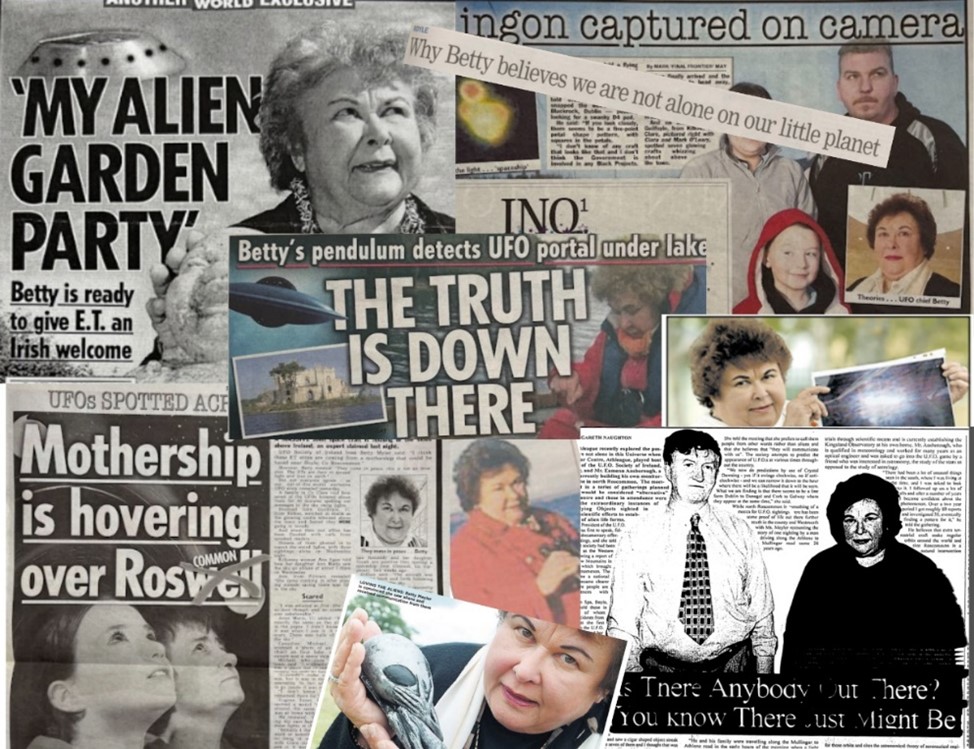
Meyler was the center of a unique subculture in Ireland, yet her legacy has largely been overshadowed by the press’s tendency to see her as an oddity. The tabloids coverage of her was a touch of “look at this crazy UFO lady.” They refer to her as ‘Roscommon’s answer to Scully from the X-Files’, as ‘madcap’ and ‘spaced out’.
The majority of sources when researching the Boyle UFO culture are fluff pieces found in tabloids, which makes it a herculean task to put together a true narrative of Meyler and the Boyle UFOs. Broadsheet features, tabloid interviews, and now archived websites have chopped and changed the story, playing a sort of cultural Telephone with events.
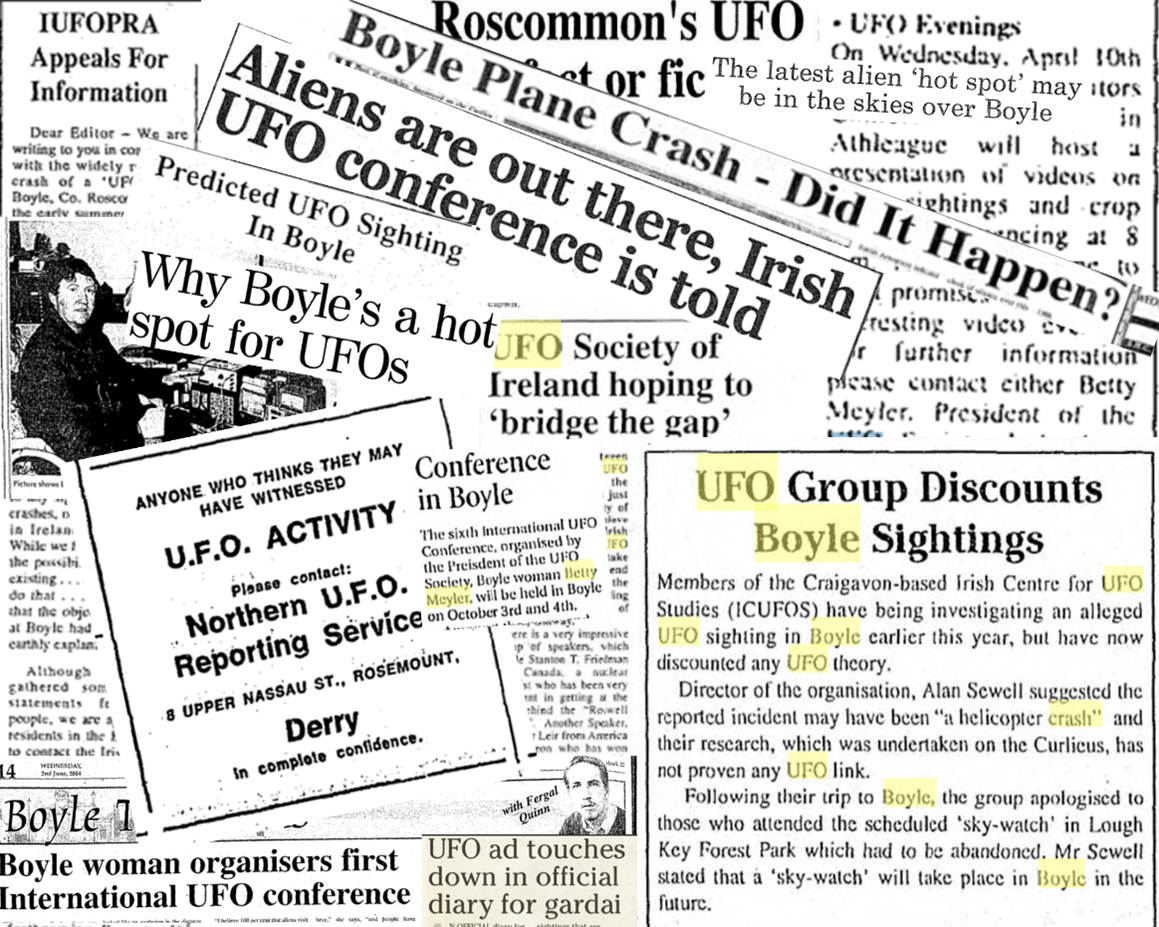
A small sample of Boyle UFO newspaper coverage – Irish Newspaper Archives
Meyler's life story is far stranger than the UFOs she chased. She was born in 1931 in India to English parents who ran an indigo plantation. Her family is described as ‘sort of imperial British’ and thus the origin of her ‘posh’ accent. Her parents were left destitute when the world discovered synthetic dyes, a development which saw the 17-year-old Betty leave to study in Scotland. Unknown to her parents, she went to London instead and met Donald Henderson, whom she married in Nigeria. The pair had three children and later fled to the Channel Islands to escape a civil war. While living there Betty took flying lessons and obtained her pilot's license under the tutelage of an RAF officer, Jack Meyler, whom she took as her second husband. The pair visited Ireland and enjoyed Sligo so much that they bought the Rock House hotel on the shores of Lough Arrow. They ran the hotel together until both their relationship and business went south in1988. Betty moved to the nearby town of Boyle and, until her death, was firmly grounded in its social fabric. Meyler was involved in nearly every club in town: The Flower Club, Dowsing Association, Boyle Camera Club, River Development group, Chamber of Commerce, Lough Arrow Fishing Club and was even the chairperson of a medieval reenactment group.
She lived on the outskirts of Boyle in a quaint bungalow crammed with an eclectic array of trinkets she had collected throughout her globetrotting life.
“Her house was as eccentric as she was, with buddhas and statues of Jesus; it seemed like she was into everything,” recalled local documentarian Pete Higgins, who spent a lot of time with her in 2009. “She had a strong opinion on what she believed in, and that made her so interesting. She was a devout Catholic, but that didn’t clash with her other beliefs. It was refreshing.”
Fergal Quinn, then a journalist working at the Roscommon Herald and now a lecturer of Journalism in Limerick, interviewed Betty at her home in 2004. “Her house had all this paraphernalia from all over the world. It was an extraordinary place; the garden had all these mad designs with ley lines all over it.” The house was a tapestry of experience woven from the threads of Betty's unorthodox life. Fergal found it difficult to synthesise her belief system, “It was hard to pin her down, whether it was UFOs, ley lines or angels, I'm not even sure ufology was her main interest. She was just completely eccentric, open-minded and incredibly sympathetic to there being things outside the norm, a nice legacy to have.”
Meyler first became interested in UFOs when she read a Sunday Mirror article from September 1997 titled “Aliens in Co Roscommon”. The article described whisperings of a May 1996 spaceship crash in the Curlew Mountains. It used an apparently renowned psychic and UFO expert, Rory Thornton, as its main source. Thornton wrote that the ship was from the planet Sunas and that he was able to contact ‘Sunasian’ pilots using telepathy
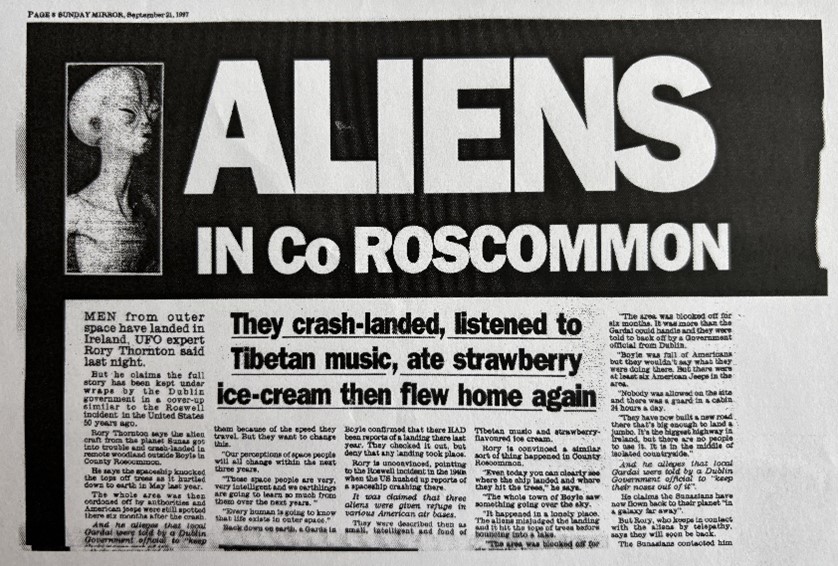
The Sunday Mirror, September 21st, 1997 –courtesy of Pete Higgins
Despite his supposed celebrity in the paranormal world, there is little trace of him before or after the Mirror article. He surfaces several times in the Galway Advertiser from 1998-99, offering medium and clairvoyant services out of a “Psychic and Healing Centre” on William Street West. None of the holistic healers in the Galway area today can recall him. His name appears again in June 2000, when he was arrested for disturbing the peace outside his daughter's house, apparently convinced that her boyfriend, Thomas Cooney, was dragging her into an evil cult. We can presume that Thornton believed Cooney was a member of the ‘Cooneyites’ or the ‘Two-by-Twos’, an ‘itinerant evangelical group’ that travelled Ireland preaching and at the time held over 200 members. He passed away a year later, on Halloween night. Thornton is one of many strange rabbit holes that surround Betty Meyler. This article is a prime example of the sort of coverage UFOs were receiving at the time. No doubt the more serious UFO researchers around at the time groaned when they saw the headline. Published Ufologist and close friend of Meyler, Carl Nally, later said that the Mirror “clumsily dropped the ball” using Thornton as a source.
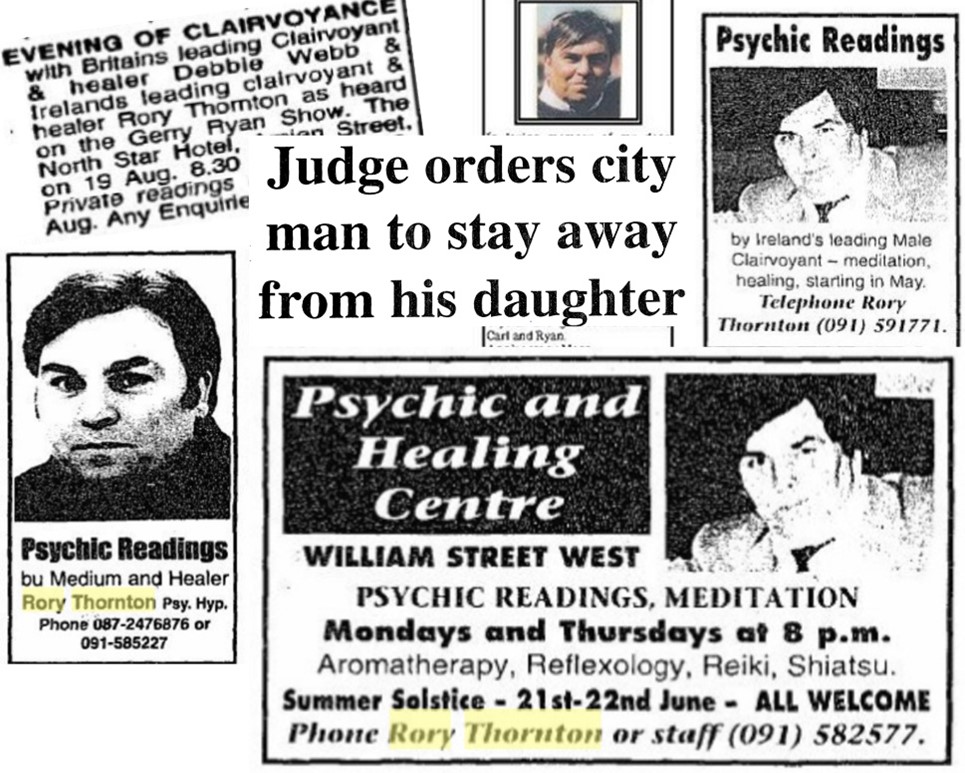
Mentions of Rory Thornton - Irish Newspaper Archives 1998-2000
Thornton's report was not the first time the story was in the news; the Roscommon Herald and the Mirror had published months earlier that there was some kind of aircraft crash in the Roscommon mountains. The story grew legs, and soon there was tales of a spaceship clipping treetops and black-suited men with foreign accents blocking public roads.
In the late 1990s, Ireland had several paranormal investigation groups, who were drawn to the frequency of UFO sightings in Boyle and the so-called ‘Roscommon Incident’. The Dublin-based IUFOPRA (Irish UFO and Paranormal Research Association) and the Belfast ICUFOS (Irish Centre for UFO Studies) all launched investigations into the crash. ICUFOS investigator Alan Sewell arrived with a Geiger counter to search for trace levels of radiation at the crash site he even claimed to have recovered debris from the craft. Around the same time, astronomer and scientific UFO investigator , Dr Eamon Ansbro , arrived at the invitation of the Boyle town commissioner and worked with Sewell on the investigation.
The pair presented their findings on 12th October in the Three Counties pub, a meeting which was enthusiastically attended by Betty Meyler. “There must have been 30 or 40 people from the town attending.” She spent time afterwards speaking to locals in attendance and was surprised at the number of them who had had experiences.
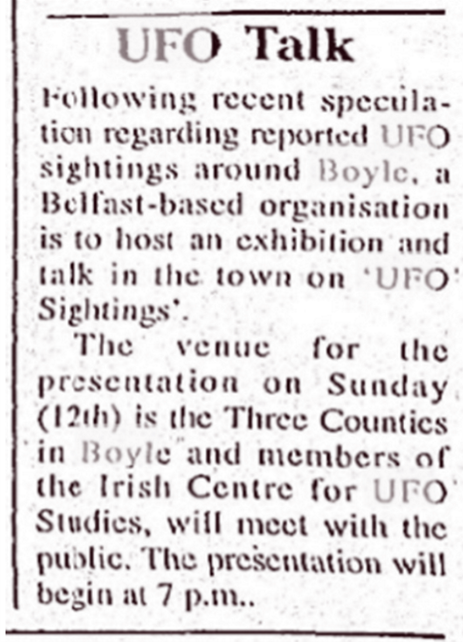
Oct 8th 1997, Roscommon Herald
In response, she founded the Western UFO Society, “a little society where we could talk, where nobody would laugh at anyone else.” Tales of the first meeting vary: in one version, the uptake was huge, and in another, she sat alone and appointed herself treasurer, secretary and president. Either way, the group's numbers steadily declined as “people were embarrassed about going up the steps to a meeting titled UFO Society.”
That changed in February 1998 when Woman's Way magazine published a two-page feature on Betty, placing her story on the cover “with none other than Robbie Williams!”
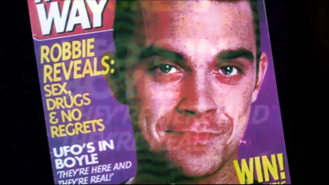
Robbie and the Boyle UFOS – Women’s Way 1998 - 'UFO' documentary 2009
“As soon as that paper hit the newsstands, I got phone calls from every radio station in the country.” She appeared on the Late Late Show and on RTÉs Nationwide, which covered the society’s Skywatch outings where the group tested their formula for predicting UFO sightings. The formula was created by Dr Eamonn Ansbro, the astromoner who travelled to Boyle to investigate the Curlew crash. Ansbro, after investigating the crash, moved full-time to Boyle and today operates the Kingsland Observatory behind his house. Ansbro, alongside several of his contemporaries, began mapping 80,000 archived UFO sightings from all over the world. They noticed that the sightings follow a pattern, and from this, they deduced a predictive formula for when they would appear. The Skywatchers met at locations where they believed UFOs would pass at a certain time, in 2026 Ansbro still holds semi-regular events following the same formula.
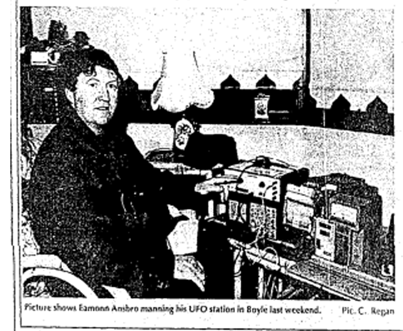
Ansbro operating his UFO station in Boyle - 17th December , 1997, The Roscommon Herald
The society was inundated with reports from all over the country, “sensible down-to-earth pillars of the community, were contacting us to tell of their experiences and sightings of UFOs.” It had grown too big and now encompassed the entirety of the island, warranting a name change to the UFO Society of Ireland. In September 1997, Meyler organised the first UFO convention in Boyle, an annual tradition which lasted until 2009 and had iterations up and down the country. The conventions drew well-known figures in Ufology from all over the world, including Stanton T Friedman, a nuclear physicist and famed investigator of the Roswell UFO crash. Pete Higgins attended one of the conventions, “I got the impression that everyone seemed to have a genuine interest; there wasn’t anybody there out of nosiness.”
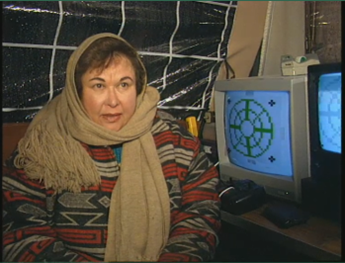
RTÉ Archives 1999 - Nationwide: Close Encounters –Boyle Skywatchers
UFOSI launched a website where members could directly submit reports and produced a monthly newsletter with county-by-county UFO predictions. They originally used Ansbro’s algorithmic formula to make predictions, but soon switched to Betty's ‘crystal dowsing’, a process which involved her spending hours asking a pendulum when UFOs might appear. Higgins, on this change, said, “I don’t know if he (Ansbro) got on with Betty, he was the very scientific side of ufology whereas betty was more into kind of outlandish ideas, I think they kind of clashed on that, I think he thought she was kind of bringing down the side with the things she talked about whereas he had a telescope and a lab.”
It seems that as the years went by, Meylers beliefs became further removed from the more rational scientific side of the UFO culture. Perhaps her development reflects a wider sense of change at the time, the more conspiratorial minds coming to the fore due to the arrival of the internet and a new ease in the spread of information. This change is reflected in the guest speakers at the UFO conventions, the majority of whom were published Ufologists, but so-called alien channellers and new age holistic healers began to creep in in the mid-2000s.
“It's understandable that the idea of UFOs and similar ideas can be corrupted. It starts as an exploring mindset that can certainly tip into the conspiracy thing –anti-medicine and the like, it probably only goes one way, unfortunately, just gets more and more extreme. If she were around today, would she have curtailed it? She wasn’t that kind of conspiracy theorist”, Higgins reflected on the woman he referred to as incredibly kind and welcoming.
Higgins concluded that her beliefs were based on a general openness to what the world had to offer, “If more people in the world were like that, it'd be a more peaceful place. She was so nice, she didn’t seem like that kind of calculating person that would make it up for the camera.”
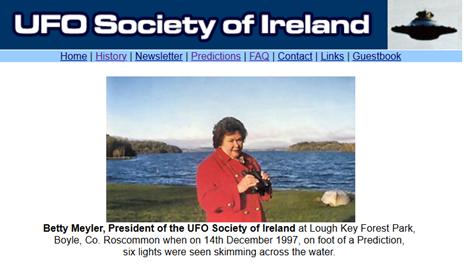
UFOSI website 2003 – Internet Archive
Meyler fell ill not too long after filming Higgin's ‘UFO’ documentary in 2009, “I went to see her in hospital shortly before she died, she was still very chipper and the same old Betty, loads of enthusiasm.”
Betty passed away peacefully in Drumderig Nursing home on Sunday, 24th October 2010. The society, her life's work and passion, was passed onto Carl Nally, who, upon hearing her name mentioned in 2026, responded with a fond but melancholic, “Ahh, Betty”.
The UFOSI website went down in 2014, and now there are seldom mentions of her on the internet apart from UFO reports on Facebook, with comments like “Someone call Betty Meyler!”
“I think the local UFO phenomena in Boyle died with her, to be honest,” says Higgins, “It's either people were fabricating stories, or maybe they were more comfortable coming forward to someone like Betty.” In 2014, there were mentions of reviving a decades-old plan to construct a UFO visitors centre, a project she strongly supported when she was alive.
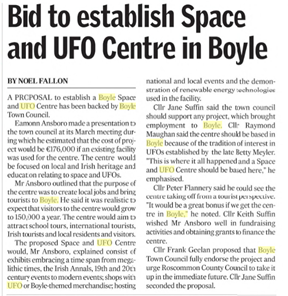
March 18th, 2014, Roscommon Herald
Betty represents a bygone age of compassionate, genuine interest in that which is on the margins of modern Irish life. The people who knew her described her as an open-minded, community-oriented person who ridiculed no one for their beliefs, even when they did not afford her the same level of respect.
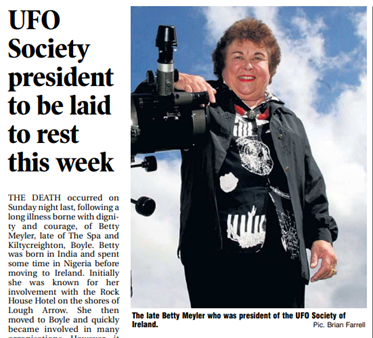
Roscommon Herald, October 26th 2010
------------------------------------------------