*Information gathered from Amanda Clark and the Heritage council. Photos are our own unless specified*
The most sacred sites for early humans were likely sources of fresh, clean water. The foreword of the book Holy Wells of County Cork by Amanda Clark defines a holy well as “a body of water where something supernatural has occurred, giving rise to its devotion.” Water is essential for life, and springs were likely the first places where humans found ritual connections to the spiritual world. The ritual practices associated with these locations evolved, swapping masks under pressure from established religions but never losing their pagan edge. Holy wells are internationally revered, but Ireland contains 3,000 of them, the highest concentration in the world.
Nearly every parish in Ireland has at least one holy well, many of which are still visited regularly, especially on their Patrún (pattern) day. A large chunk of holy wells have been neglected or forgotten entirely. This leads people like Amanda Clark to travel the country documenting them, mostly relying on old maps and archaeological data to find them.
The majority of wells originate from underground springs and are small sources of fresh, clean water, usually encased in a “wellhouse.” They can be found on mountains, in fields, beside the sea, or even in caves. Wells on mountaintops or by the sea are particularly revered due to the perceived miraculous existence of fresh water on such terrain.
Holy wells can take many forms. For example, Gougane Barra in West Cork is a holy lake. It is revered as it is said that St Finbarr drove the sea serpent “Tú” from its waters. They also come in the form of “bullauns,” which comes from the Irish word ballán, meaning bowl or little hole. These bullauns are man‑made hollows in stones that are said to hold water that never dries up. Bullauns are often associated with curing warts; this subset of wells is known as Tobar na bhFaithní (wart wells).
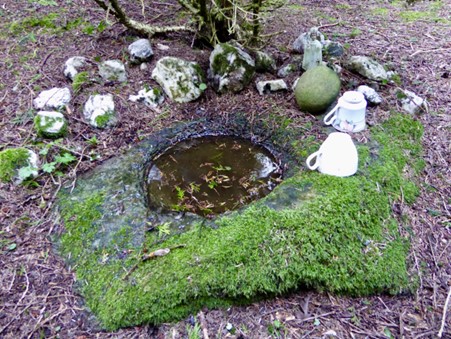
- Source roaringwater journal
It was widely believed for millennia that water from holy wells could cure many common ailments. A large number of wells are named after the particular issue they were said to cure. Issues like sore eyes, headaches, back pain, infertility and even mental illness could be relieved through various ritual uses of well water. Tobar na nGealt, or “Well of the Lunatics,” was thought to cure mental illness. Curiously, modern tests of this well water showed high levels of minerals such as lithium, which is used to treat various mental illnesses today.
History of Holy Wells in Ireland
According to Amanda Clark, many wells are pre‑Christian and have existed for more than 2,000 years, if not more. The ritual practices performed at wells are probably the same as those done millennia ago, meaning wells are an “extraordinary example of connection and continuity.” Old Irish royal sites such as the Hill of Tara and Rathcroghan have sacred springs nearby for their ritualistic significance during the coronation of kings.
It has been proven that some wells are fulacht fiadh, a Bronze Age cooking site that consists of a wood‑ or stone‑lined, water‑filled trough. Stones were heated and dropped into the trough, boiling the water which in turn cooked straw‑wrapped meat.
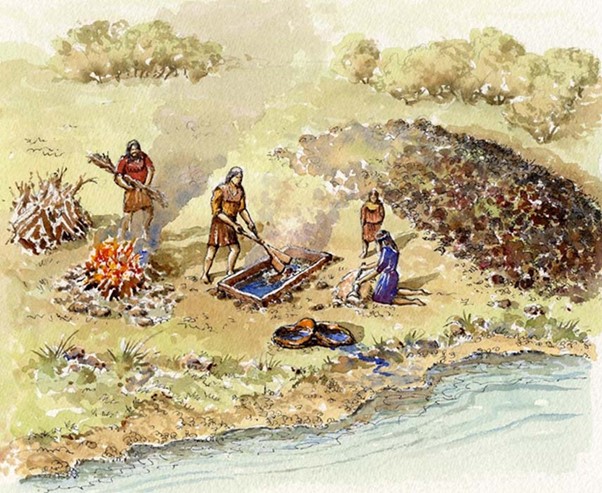
- Source Ancientorigins.net
Early Christians incorporated the wells rather seamlessly into their belief system by replacing the original deity with a Christian saint. This meant wells were left unharmed by the religious conversion of Ireland, leaving us with an incredibly rare mixture of Catholic/pagan folk belief.
Wells are usually named after or associated with early Irish Christian saints. Folk stories regarding the origins of many wells tell of them springing up where a saint sat, blessed, or slept. Many wells carry legends that symbolise Christianity’s victory over paganism.
It is said that St Patrick (massive wanker) carried a golden staff that, whenever it was stuck in the ground, a well would spring up. This staff was said to have belonged to Jesus, who foresaw Patrick’s birth and hid the staff away. The staff existed but was destroyed by the dastardly King Henry VIII during the Reformation. St Patrick spent time travelling the land, building churches and blessing pagan wells to convert them to Christianity. What an absolute melt.
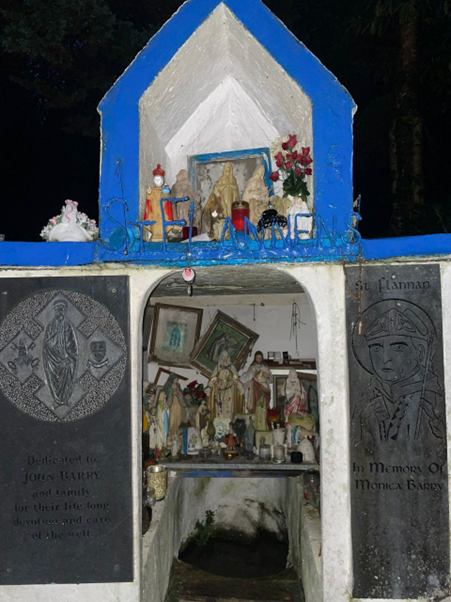
- common blue and white colors on this well house
Holy wells continued to be important cultural sites until the Penal Laws of the late 17th century. The Penal Laws were a series of shitty restrictions put in place to suppress the public practice of Catholicism. These laws made Mass illegal, which led to the forced transition of worship to outdoor locations such as Mass Rocks (Carraig an Aifrinn) and wells.
The Catholic Emancipation Act of the 1820s saw many schools and churches being built all over the country. The increased number of churches and the rise of a reserved clergy in post‑famine Ireland saw worship being performed inside. Beautiful cultural practices like dancing at the crossroads, fairy belief, traditional wakes and pilgrimage to the well were seen as backward and representative of old, uncivilised Ireland. These practices were replaced by the dry, soulless rigmarole of weekly Mass, confession and novenas. Nonetheless, the traditions persevered; the wells were useful beyond spirituality and remained important in places where freshwater and doctors were scarce.
The church dimmed our sparkle (in many hundreds and thousands of ways across Irish history). All you young Irish out there, let's take a little bit back from them. LMFAO061 implores you not to go to Mass. Instead, organise a gig/rave at your local well. Invite your enemies and get into massive brawls that end with hugs and kisses. At midnight, crawl into the well naked and bask in its water, washing yourself of any and all misgivings. Alternatively, just keep an eye out for a well on your travels; if you pass one, give it a big kiss.
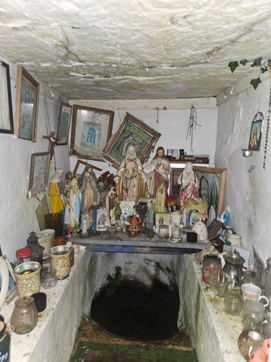
- think we would have enjoyed this well more if it wasn't so dark
Feast days
The dates that certain wells are visited on were carried over when they were Christianised. Wells are traditionally visited on the pagan festivals of Imbolc (February 1st, now St Brigid’s Day), Bealtaine (May 1st) and Lughnasa (August 1st).
The first of August or the last Sunday in July is a very important time for wells. Communities traditionally gathered at the parish well and spent the day dancing, drinking, playing games, and just straight‑up partying. The tradition goes back hundreds of years and involved people getting very drunk and then participating in faction fighting. These events got so crazy that the shitarse church in the 1660s banned “dancing, flute‑playing, bands of music, riotous revels and other abuses when visiting holy wells.” Ask an older Irish person, and they likely have memories of travelling to the wells on feast days as part of the local celebrations. It is documented that at Malin Well in Donegal, people would strip naked post-ritual and play in the water, collectively washing each other of their sins. Perhaps the first LMFAO061 social should be a couple of cans on a feast day by the well on the Groody Road.
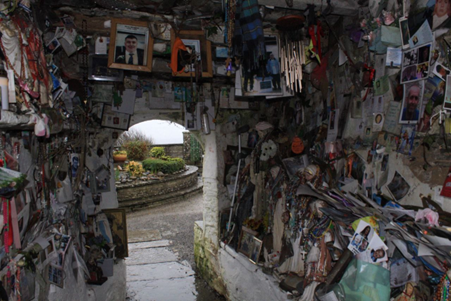
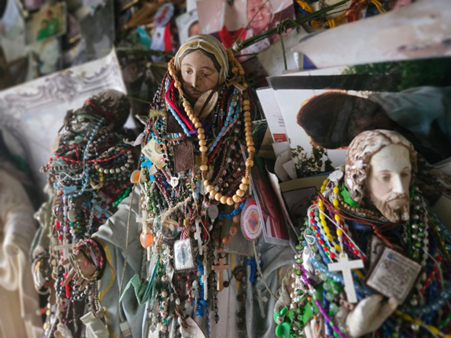
- so nice , walls covered in items left to commemorate loved ones
Doing the rounds
Pilgrimage to a well is known as “doing the rounds.” On the feast day associated with the well, pilgrims would arrive and perform certain rituals before using the water. Many wells contain sacred trees or stones that act as “stations” which are stopped at or utilised in the ritual. The actual practices vary widely; the number of prayers, direction of travel around the well and the number of stations are very important when seeking to receive the curative properties of the water for yourself or a loved one.
Once the rounds are completed, the well water is drunk, the feet or hands washed, adjacent herbs or plants consumed, or belongings like rosary beads blessed. One wild practice is the gathering of well moss to cure a sick child. The moss is boiled in milk and fed to the infant to cure their ailment.
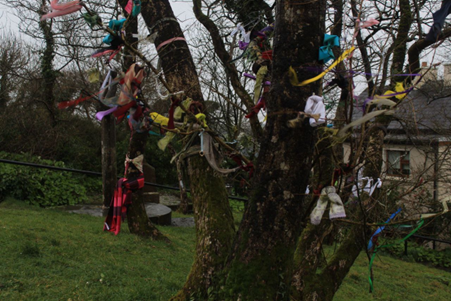
- a rag tree (DO NOT hammer coins into these fool)
Holy medals, broken crockery, coins, rags tied to trees, items relating to a dead loved one, flowers, buttons, statues or even food like butter are all left as offerings to the well. In modern times, it is not uncommon to see offerings left to appeal for a good outcome in a certain situation: lighters to quit smoking, pregnancy tests for a safe birth, inhalers, pens for exams — the list goes on and on.
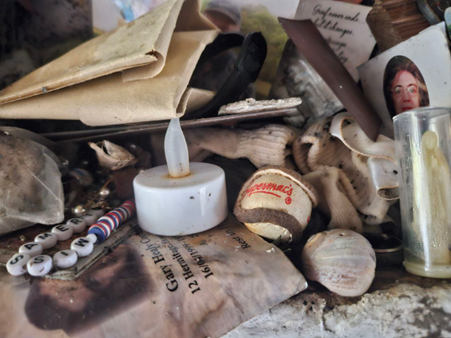
- offerings left behind
Horrific creatures who live under the surface….
There are stories of magical creatures living inside the wells. If you were to catch a fish from a holy well, it would mean certain death. Creatures like fish, snails or worms were seen as omens of good fortune, and harming one meant bringing serious harm upon yourself. There is a story found in the National Folklore Collection that says in a certain well there “is a little worm in it, and if he comes up to the top of the water, you or someone belonging to you will die.” In “The Snail’s Well” on Old Pound Street, Sligo, it is said that a snail is seen leaving the well every seventh year and that it is an enchanted being which can control the water and will one day drown the entire town.
I hope for your sake and my own, dear reader, that we never encounter such vile beings.
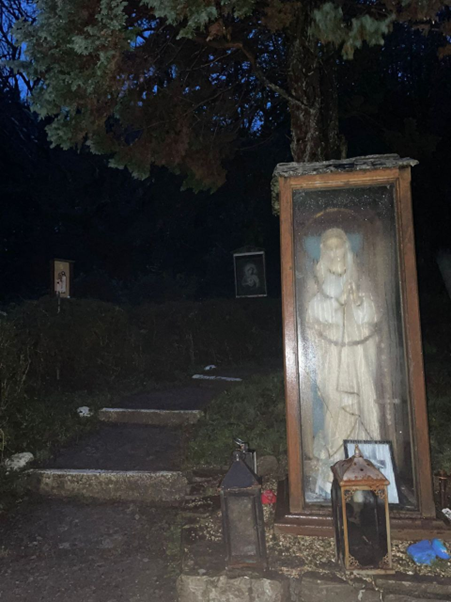
- horrible feeling in stomach for the duration of this well visit. Made something angry.
Leave them alone please they are important
Holy wells are incredibly important historic locations in Ireland and are mostly left alone due to folk belief and cultural reverence. They have generally not been modified and are havens for biodiversity. Rare native vegetation and insects thrive in and around wells, contributing to the health of nearby native trees such as hawthorn and yew.
Over the next number of months, we will be starting a series called “Well of the Week,” a bi‑ or tri-weekly series where LMFAO061 researchers will visit a well and document its features. The first of these will be posted in the coming days and covers a lesser known well on the Groody Road.
If you would like to contribute to ‘Well of the week’, then you are more than welcome. When visiting a well, be very careful not to damage any part of it. Do not take any item with you, and make sure that anything you leave behind is biodegradable. There are many wells around the country where the water and trees have been poisoned by the leaving of coins in the water and bark. If the well is degraded or in disrepair, perhaps do a little clean-up. Reach into the water and remove any coins or plastic debris, then leave them by the wellside. Take some pictures and maybe gather a little water as a souvenir. If you are so inclined, you can research the folklore of the well on Dúchas and do a write-up that we can post on the website. Remember to be respectful, no matter if your catholic, pagan or an archaeologist you are all there simply to enjoy one of the only countrywide cultural artefacts that we have left. In a country where our people, language, stories, and music were all systematically killed by colonial cunts over 800 years of oppression, at least we can still gather around these living springs and know that at least one part of our culture is still there bubbling away.
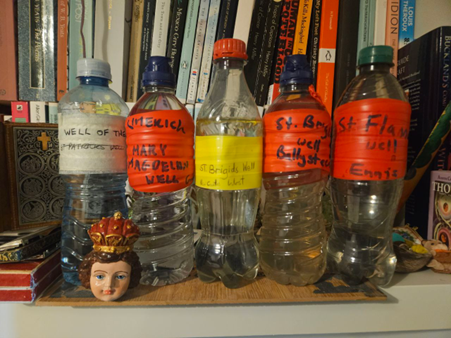
- the LMFAO061 holy well water collection is growing